The booming popularity of off-grid solar setups, marine upgrades, and remote industrial projects has triggered a massive surge in demand for reliable power storage. Imagine being stationed at a remote off-grid site, only to have your critical equipment fail because a bargain-bin power bank could not hold a charge. I have seen too many melted terminals and bloated cells in the field to take power storage lightly. Navigating this rapidly expanding market often feels like walking through a minefield. Consumers and project managers face a constant barrage of options, ranging from premium, high-cost units to cheap, potentially dangerous knock-offs. Finding out exactly where to source a reliable lithium ion battery pack without getting burned is a valid and common frustration.
This comprehensive guide walks you through the nuances of finding dependable energy storage. We will break down how to select the right specifications for your unique application and how to dodge prevalent e-commerce scams. By exploring top-tier retailers, specialized use cases, and practical engineering tips for spotting fakes, you can ensure your investment is safe and efficient.
Key Takeaways
Know Your Chemistry: Understand the critical differences between standard lithium-ion and Lithium Iron Phosphate before making a purchase.
Buy Direct for Warranty: Purchasing a lithium ion battery pack directly from reputable suppliers guarantees better customer support and valid warranties.
Beware of Fakes: Online marketplaces are flooded with exaggerated capacity claims. Always verify the battery weight and the quality of the internal components.
Match the Application: Where you buy depends entirely on what you need. Specialty suppliers exist specifically for heavy-duty industrial and solar storage applications.
Shipping Matters: Lithium batteries are classified as hazardous materials. This classification heavily impacts shipping times, costs, and international availability.
Understanding Your Needs Before Sourcing
Before blindly searching for suppliers or adding items to a cart, you must clearly define your actual load requirements. Think of this section as a practical engineering crash course. Your hard-earned money must be spent wisely on a system that fits your exact parameters.
Calculating your daily energy consumption is the foundational step. You need to map out every appliance—from overhead LED lights to heavy-duty induction motors—to determine your required Amp-hours. Furthermore, selecting the correct system voltage is absolutely critical for system compatibility. A 48V system is highly efficient for large home solar arrays because it minimizes voltage drop over long cable runs. In contrast, a 12V setup remains the plug-and-play standard for most smaller marine vessels.
Not all lithium cells are created equal. Choosing the wrong chemistry can lead to premature failure or severe safety hazards. Standard lithium-ion is incredibly energy-dense, making it the go-to choice for compact electronics where space is at a premium. However, Lithium Iron Phosphate trades a bit of that density for unparalleled safety and longevity. This chemistry has become the undisputed gold standard for solar and marine applications. It is far less prone to thermal runaway and can easily endure thousands of deep discharge cycles. When planning for massive, grid-scale resilience, engineers often look beyond basic lithium, integrating long-duration energy storage to handle seasonal dips in renewable generation.
To make the selection process easier, here is a core comparison of common battery technologies used in the field today.
Feature
Lithium Iron Phosphate
Standard Lithium-Ion
Traditional Lead-Acid
Cycle Life
3,000 to 5,000+ cycles
500 to 1,000 cycles
300 to 500 cycles
Safety Profile
Extremely high, stable chemistry
Moderate, requires strict thermal management
Low fire risk, but emits toxic gas if overcharged
Upfront Cost
High
Moderate to High
Low
Best Application
Solar, RV, Marine, Off-grid
Power tools, EVs, small electronics
Starter batteries, extreme budget setups
Top Trusted Channels for Procurement
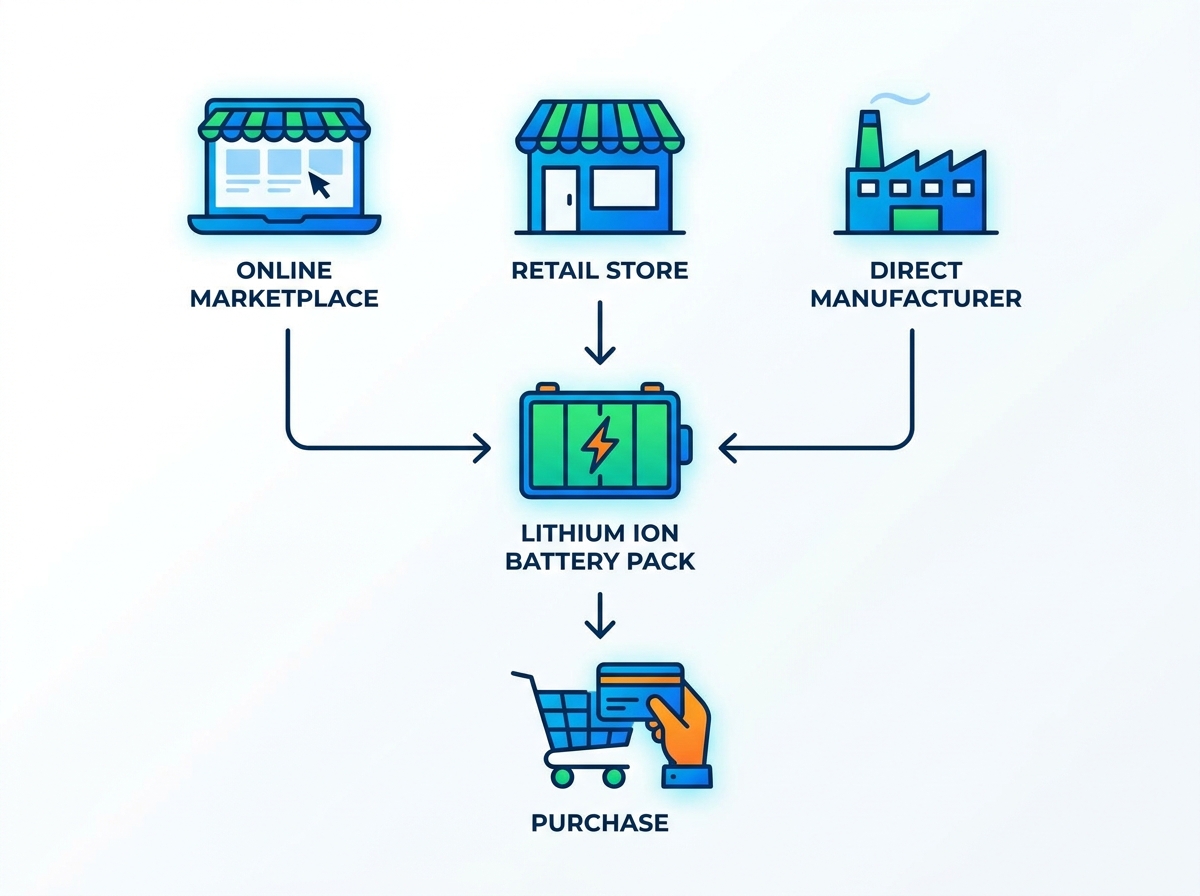
Once you know your specifications, the next hurdle is selecting a trustworthy vendor. The market is segmented into several distinct categories. Each offers different levels of reliability, pricing, and customer service.
Purchasing directly from established manufacturers is generally the safest route. By cutting out the middleman, buyers often receive the most up-to-date hardware revisions. More importantly, direct purchases usually offer the best technical support, crystal-clear warranty terms, and a strict guarantee of authentic products. If a cell fails while you are off-grid, having a direct line to the manufacturer's engineering team is invaluable.
There are numerous online storefronts dedicated exclusively to off-grid living and renewable energy setups. These retailers act as curators. They test and vet the equipment they carry. They often sell bundled kits that include the battery, inverter, and solar charge controller. This ensures seamless communication between components. Buying from these specialists also grants you access to expert advice on properly sizing your battery bank.
General e-commerce platforms offer undeniable convenience. Fast shipping, easy returns, and highly competitive pricing make them attractive to budget-conscious DIYers. However, this convenience comes with a high risk of encountering counterfeit cells and abysmal after-sales support. To navigate these marketplaces safely, filter out bad sellers by rigorously checking third-party reviews. Scrutinize seller histories and look for official storefronts of recognized manufacturers rather than fly-by-night vendors with random alphanumeric names.
Sizing and Selecting for Specific Applications
Different environments demand different build qualities. A stationary battery in a climate-controlled basement does not need the same ruggedization as a unit bouncing down a washboard dirt road. You need actionable standards to match your purchase with your reality.
For mobile applications, focus on suppliers that offer rugged, vibration-resistant, and weatherproof enclosures rated at IP65 or higher. Specifically, marine and mobile enthusiasts must prioritize units with built-in cold-temperature charging protection. Attempting to charge a frozen lithium cell will cause irreversible lithium plating and instantly destroy the battery. A smart internal management board with thermal sensors is absolutely non-negotiable here.
If you are outfitting a house or a commercial facility, you should look into server-rack batteries and wall-mounted power walls. Focus on suppliers that offer highly scalable systems and closed-loop communication compatibility with major solar inverters. For massive commercial setups, standard lithium banks are often paired with advanced generation tools. By integrating a hydrogen energy solution, facilities can achieve true independence. These hybrid setups boast impressive parameters, such as a 150kW to 2MW power output range and fuel cell lifespans exceeding 20,000 hours. The lithium bank handles the immediate, high-draw transient loads, while the hydrogen system provides weeks of deep, zero-emission seasonal storage.
Commercial buyers looking for custom energy packs for delivery fleets, warehouse robotics, or heavy machinery require a completely different supply chain. Industrial suppliers focus heavily on remote fleet monitoring, specialized telematics, and custom engineering to fit unique chassis constraints. These business-to-business transactions prioritize long-term service contracts and rigorous safety certifications over simple retail packaging.
Industry Trends: The Shift Toward Hybrid and Decentralized Power
Recent market analyses and shifting search behaviors reveal a fascinating evolution in how both consumers and businesses approach energy storage. The quest for reliable power is increasingly tied to the desire for total grid independence and resilience against extreme weather events. We are witnessing a massive transition toward decentralized micro-grids. This shift is largely driven by supply chain vulnerabilities and fluctuating utility costs.
Buyers are no longer just looking for a simple drop-in replacement. They are investing in comprehensive, smart-home ecosystems. This trend has spurred significant interest in hybrid technologies. Commercial sectors and large-scale off-grid developers are frequently exploring hydrogen power integration to understand how modern fuel cells work in tandem with high-capacity lithium banks. As raw material supply chains continue to shift globally, expect to see an increase in localized battery manufacturing. There is also a much stronger emphasis on sustainable, closed-loop recycling programs to reclaim valuable metals.
The Secondary Market: Risks and Rewards
For the budget-conscious DIYer or the solar hobbyist, the secondary market offers a tempting alternative to brand-new retail prices. A growing industry now exists around second-life electric vehicle batteries and repurposed medical or server cells.
The primary advantage here is massive cost savings. You can often secure cells for pennies on the dollar compared to retail. However, this comes with the inherent risk of reduced cycle life, mismatched cell degradation, and a complete lack of warranty. Reputable secondary market platforms and dedicated enthusiast forums are the best places to facilitate safe trading. Community members in these spaces often hold sellers accountable.
Never buy a used cell blindly. Educate yourself on what to ask the seller. Request documented proof of the cycle count, internal resistance testing, and recent capacity testing results. As an engineer, I always look at the internal resistance first. A reputable seller will have no problem providing a detailed spreadsheet of the cells' current state of health before you hand over any cash.
Spotting Counterfeits in the Wild
A major pain point frequently discussed in engineering forums is the alarming prevalence of fake lithium cells. Unscrupulous manufacturers prey on buyers looking for a cheap deal, utilizing clever tricks to mask inferior products. How do you avoid this trap?
Lithium chemistry has strict physical limits. If a cheap lithium ion battery pack claims an impossible capacity rating for its physical footprint—like a battery the size of a shoebox claiming 400 Amp-hours—it is undeniably a scam. Always cross-reference the physical dimensions with known, reputable products to see if the math adds up.
Lithium cells have a very predictable weight-to-capacity ratio. Scammers know that buyers expect a certain heft. Fakes often use bags of sand, glass, or smaller, low-capacity cells hidden inside a large plastic casing to mimic the appropriate weight. If a battery feels suspiciously light, or if the weight distribution feels completely off-center, proceed with extreme caution.
A cheap pack without a proper battery management board is not just a waste of money. It is a literal fire hazard. This board is the brain of the operation, responsible for balancing cells and preventing catastrophic failures. Before buying, verify through teardown videos or detailed specification sheets if the pack actually features low and high voltage disconnects, short-circuit protection, and active temperature sensors.
Shipping Restrictions and Compliance
Buying massive power banks is not like ordering a pair of shoes online. Global shipping laws heavily regulate how these energy-dense items move across borders.
Due to the risk of fire if punctured or short-circuited, lithium batteries are classified under strict hazardous materials shipping regulations. Consequently, these batteries almost always require specialized ground shipping and an adult signature upon delivery. Air freight is generally prohibited for large capacities, which naturally extends delivery timelines.
Sourcing directly from overseas factories can yield incredible wholesale prices. Yet, buyers must weigh these savings against long lead times, potential customs delays, and hidden import tariffs. Buying from localized warehouses usually guarantees faster shipping, easier returns, and less bureaucratic headache if a unit arrives damaged.
Conclusion
Successfully navigating the modern energy storage market requires a blend of technical knowledge and consumer vigilance. By understanding the specific chemistry your project demands, verifying the reputation of the seller, and knowing how to spot red flags like impossible capacity claims, you can secure a reliable power source for years to come.
While the allure of a dirt-cheap lithium ion battery pack is undeniably tempting, cutting corners on energy storage rarely ends well. Investing in a high-quality unit from a reputable source pays massive dividends in safety, longevity, and ultimate peace of mind. Whether you are building a simple weekend camper setup or engineering advanced energy systems for commercial off-grid operations, always prioritize quality and verified specifications. For industrial-grade reliability, integrated setups, and professional power solutions, explore the verified options at GIC Supplier to ensure your next project is powered safely and efficiently.
FAQ
What is the best lithium battery for cold weather?
If you plan to operate in freezing temperatures, you must choose a Lithium Iron Phosphate battery equipped with internal heating pads and a low-temperature charging cutoff. Standard lithium cells cannot absorb a charge below freezing without suffering permanent damage. Premium models automatically use the incoming charge current to warm the internal heating pads before allowing power to flow into the cells.
How do I calculate what size lithium battery I need?
Start by listing all the devices you plan to power. Multiply the wattage of each device by the number of hours you will run it daily to get your total Watt-hours. Divide that total by your system voltage, such as 12V or 24V, to find the required Amp-hours. Always add a 20 percent buffer to your final calculation to account for inverter inefficiencies and to avoid draining the battery to absolute zero.
Can I replace my lead-acid battery with a lithium one?
Yes, this is commonly referred to as a drop-in replacement. While the physical dimensions might perfectly match your old lead-acid battery box, you must ensure your existing charger, alternator, or solar controller is compatible with lithium charging profiles. Lithium requires a specific, constant-current and constant-voltage charge without the equalization stages used for traditional lead-acid units.
Why are lithium ion battery packs so expensive?
The upfront price tag reflects the high cost of raw materials like refined lithium, cobalt, and nickel. Additionally, you are paying for the complex internal management board that keeps the cells safe. However, when you calculate the cost per cycle, lithium is actually much cheaper than lead-acid over a ten-year lifespan because it lasts up to ten times longer.
Can I buy lithium batteries locally at auto parts stores?
While some auto stores do carry small lithium jump starters or compact powersport batteries for motorcycles, large deep-cycle lithium batteries for heavy applications are rarely kept in stock. These specialized, high-capacity units are usually best purchased online through dedicated suppliers who can ensure proper storage and rotation of their inventory.
How long do lithium batteries actually last?
When properly maintained, you can expect realistic cycle life expectations of 3,000 to over 5,000 cycles for modern stable chemistries. If you cycle the battery once a day, that translates to well over ten years of reliable daily use before the battery degrades to 80 percent of its original capacity.
Is it safe to buy a lithium ion battery pack from overseas?
It can be perfectly safe, provided you do your due diligence. You must buy from a verified manufacturer with a long track record, excellent community reviews, and proper shipping certifications. Keep in mind, however, that if something goes wrong, executing warranty claims can be incredibly difficult and expensive due to international hazardous material shipping costs.