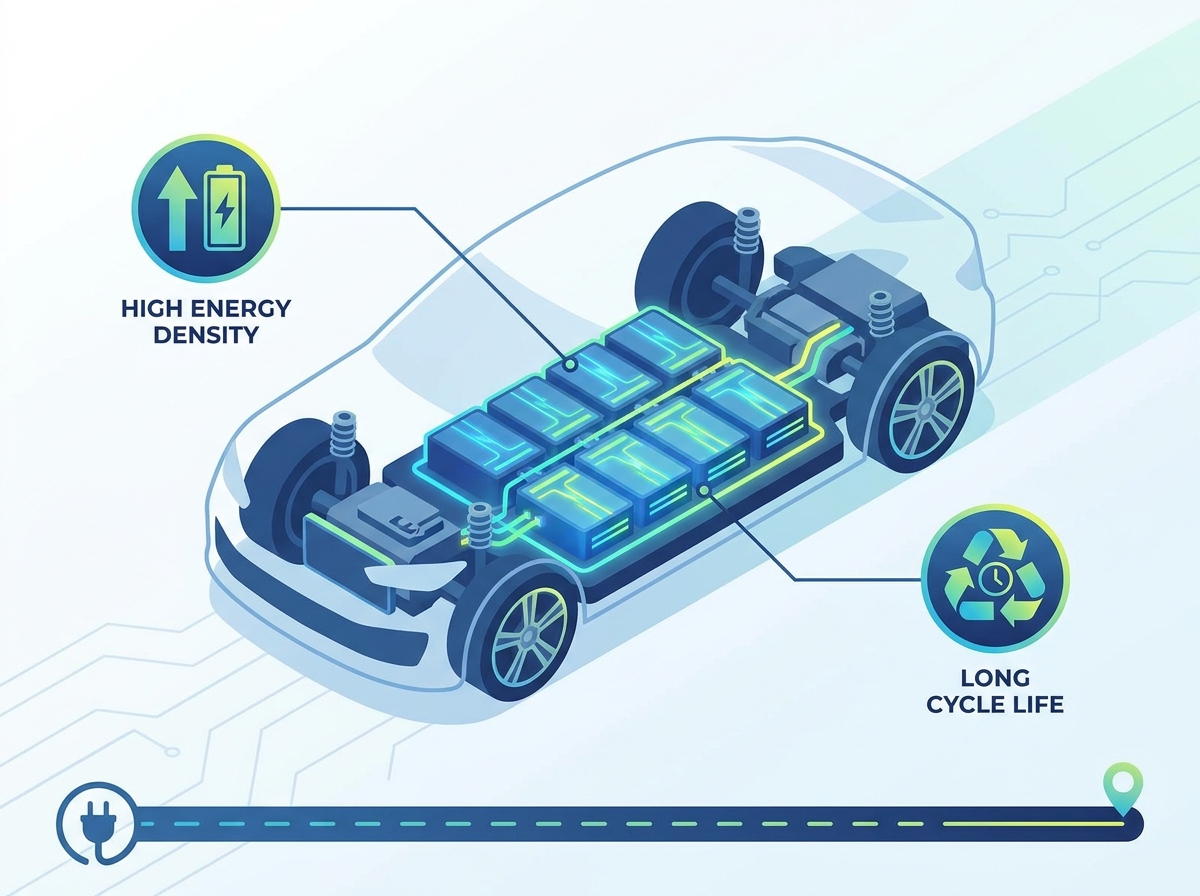
The electric vehicle market is experiencing explosive, unprecedented growth. Millions of new units hit global roads each year. At the core of this monumental shift from internal combustion engines to sustainable mobility lies a highly engineered piece of technology. It serves as the beating heart of modern electric vehicles. It dictates everything from acceleration to total driving range. Out of all the chemical compositions tested over the past century, one specific chemistry became the undisputed gold standard. Why did this happen? This comprehensive guide explores the underlying science, the intricate manufacturing processes, and the economic factors driving this power unit.
Key Takeaways:
Unmatched Energy Density: These advanced cells store significantly more energy in a lighter, smaller footprint compared to legacy chemistries. This acts as the direct cure for consumer range anxiety.
Long Lifespan and Low Maintenance: A modern power unit can confidently last for hundreds of thousands of miles. It requires virtually zero active maintenance and boasts an exceptionally low self-discharge rate.
Scalable Manufacturing: The engineering process of assembling individual cells into modules, and modules into a complete enclosure, is highly scalable and increasingly cost-effective.
Proven Reliability: Despite the hype surrounding experimental technologies, this liquid-electrolyte solution remains the most commercially viable and rigorously tested option for global automakers.
The Anatomy of Modern EV Energy Storage
At its most fundamental level, this system is a sophisticated, rechargeable energy storage mechanism. It relies on the continuous, reversible movement of ions between an anode and a cathode through a liquid or polymer electrolyte. When a driver presses the accelerator, ions flow one way to release electrical energy to the motors. Conversely, when the vehicle is plugged into a charger, the ions flow back to store energy. Sourcing these complex systems from a reputable battery pack supplier ensures that they are engineered to the exact specifications required for maximum vehicular efficiency and safety.
To truly understand the dominance of this technology, we must look at first principles. Lithium is the lightest metal on the periodic table. It is also the least dense solid element known to science. Furthermore, it boasts an incredibly high electrochemical potential. This unique combination makes it the absolute perfect candidate for creating high-voltage, remarkably lightweight power units that do not weigh down the vehicle chassis.
As an engineer who has spent years designing thermal management systems and coolant pumps, I can attest that a modern EV power source is much more than just a sealed box of chemicals. It consists of the cathode, the anode, the electrolyte medium, and a highly porous separator that physically prevents catastrophic short circuits. The Battery Management System, commonly referred to as the BMS, acts as the central nervous system. Imagine driving through a scorching desert environment. The BMS actively monitors individual cell temperatures. It triggers liquid cooling pumps to circulate coolant through internal cold plates. This precise fluid dynamics engineering keeps the internal chemistry safe, stable, and fully optimized.
The Dominant Performance Metrics Driving the Market
Automakers do not choose their core components lightly. The distinct performance metrics of this specific chemistry make it the premier choice for modern, highway-capable vehicles. It directly addresses the primary concerns of everyday drivers.
Energy density is typically measured in Watt-hours per kilogram. These advanced batteries store vastly more energy in a smaller, lighter physical footprint compared to alternative chemistries. The physics here are straightforward. A lighter car inherently requires less energy to move. This creates a compounding effect that significantly extends driving range, allowing modern vehicles to travel 300 to 400 miles on a single charge.
One of the largest consumer pain points during the transition to electric mobility has been charging time. Fortunately, this chemistry is uniquely capable of accepting high-current direct current fast charging without degrading as rapidly as older battery types. Drivers can pull into a highway rest stop and replenish 80 percent of their capacity in just 20 to 30 minutes. This makes cross-country road trips a practical reality.
Electric vehicles are famous for their thrilling, instant torque. This is made possible because these packs can safely discharge a massive amount of electrical power in a fraction of a second, a metric known as a high C-rate. This rapid power delivery gives electric cars their signature, seamless acceleration off the starting line.
Legacy Chemistries vs. Modern Standards
To appreciate where the industry stands today, it is helpful to look at the technologies that were ultimately left behind in the pursuit of the ultimate electric vehicle. Let us examine the core engineering differences.
Specification
Modern Lithium-Based
Lead-Acid
Nickel-Metal Hydride
Energy Density
150 to 250+ Watt-hours per kilogram
30 to 50 Watt-hours per kilogram
60 to 120 Watt-hours per kilogram
Cycle Life
2000 to 5000+ cycles
300 to 500 cycles
500 to 1000 cycles
Thermal Management Need
High — Requires active liquid cooling pumps
Low — Passive cooling sufficient
Moderate — Air cooling often used
Commercial EV Viability
The Ultimate Standard
Obsolete for propulsion
Largely phased out for full EVs
Lead-acid batteries have been used in standard car ignitions for decades, but they are entirely unsuitable for full propulsion. Primarily, lead-acid is far too heavy for the limited range it provides. Furthermore, lead-acid chemistry degrades rapidly under deep cycling—meaning they are heavily drained and recharged. In contrast, modern lithium systems thrive in these exact conditions, offering thousands of cycles before noticeable degradation occurs.
Nickel-Metal Hydride holds an important place in automotive history, famously powering early hybrid vehicles. However, full battery electric vehicles require entirely different specifications. Nickel-Metal Hydride batteries run hot and suffer from lower energy density. The modern standard superseded them because it packs more power into a smaller space and interfaces flawlessly with advanced liquid cooling systems. This fluid integration is an absolute necessity for high-speed highway cruising.
Cell to Pack Engineering and Manufacturing Realities
Demystifying the production process reveals the incredible engineering behind these power systems. Building a functional unit is a multi-stage assembly process. It requires precision automation and a highly specialized manufacturing partner to execute flawlessly.
At the base level, manufacturers produce cells in three main formats. These include cylindrical forms—similar to traditional AA batteries but larger—flexible pouch packets, and rigid prismatic blocks. Each format has distinct advantages regarding space utilization, thermal management, and structural rigidity.
Looking at practical engineering applications, a standardized commercial pack from a top-tier battery provider often features parameters designed for extreme reliability. For instance, high-performance industrial modules boast a nominal voltage of 51.2V and capacities ranging from 100Ah to 200Ah for scalable storage. They utilize robust prismatic cells and integrate IP67-rated enclosures to completely block moisture and dust. The journey from a raw chemical cell to a functional vehicle component happens in distinct steps. First, engineers group tested cells into robust metal frames called modules. Finally, these modules are wired together into the final enclosure, where the liquid cooling plates are integrated, and the BMS is connected to govern the entire system.
Industry Trends and Economic Shifts
The automotive industry is currently witnessing a massive strategic pivot. Recent market analyses highlight an industry-wide shift in how battery chemistries are deployed. This is largely driven by a desire for localized supply chains to mitigate geopolitical risks and enhance overall safety.
Rather than completely abandoning the current technology, the industry is innovating heavily within the same chemical family. There is a massive surge in the adoption of Lithium Iron Phosphate, or LFP, chemistries. Automakers heavily prefer LFP for standard-range vehicles. This variant entirely bypasses volatile cobalt supply chains, drastically lowers production costs, and offers superior thermal stability.
Solid-state batteries are frequently heralded as the next big technological leap, promising to replace liquid electrolytes with solid conductive materials. However, while they represent the future, traditional liquid-electrolyte systems maintain an absolute stronghold today. This dominance is due to heavily optimized, highly scalable global manufacturing infrastructures that already exist. Industry consensus suggests it will likely take until the early 2030s before solid-state technology can truly compete on a commercial scale.
A Practical Guide to Component Selection
How do you select the right power unit for a commercial fleet or a specialized engineering project? Do not rely on generic, abstract specifications. Sourcing the right component is the most critical business decision in your product lifecycle. Use this hard-coded engineering checklist for your selection process:
Volumetric Energy Density: Ensure the pack delivers at least 160 Watt-hours per kilogram for mobility applications to prevent chassis overweighting.
Thermal Management Integration: The pack must support active liquid cooling. Verify that the internal coolant flow channels can handle the pressure from standard automotive water pumps without leaking.
Cycle Life Guarantee: Demand a minimum of 3,000 cycles at an 80 percent Depth of Discharge to ensure long-term commercial viability.
Safety Certifications: Look for mandatory UN38.3 compliance for safe transportation and UL certifications for operational safety.
To source components that meet these strict parameters, reviewing a detailed battery manufacturer company profile is an essential first step. Working with a vetted, deeply experienced manufacturer is non-negotiable for project success.
Conclusion
This advanced energy storage technology remains the unrivaled choice for the electric vehicle industry. It offers an intricate, highly optimized balance of energy density, physical weight, cost-effectiveness, and daily longevity. While the technology will inevitably continue to evolve with new chemical tweaks, it has firmly established the foundation of the modern electric vehicle revolution. Stop compromising on your energy storage requirements. For specialized engineering projects requiring rigorous thermal stability and high cycle life, explore the robust product lineups available at GIC Supplier to find the exact parameters your next vehicle demands.
FAQ - Frequently Asked Questions
How long does a modern EV power unit typically last?
Under normal driving conditions, these systems are designed to last between 10 to 20 years. This translates to roughly 100,000 to over 200,000 miles. This lifespan varies slightly depending on the specific vehicle manufacturer, ambient climate conditions, and the owner's daily charging habits.
Are these high-voltage systems safe for daily driving?
Yes, they are exceptionally safe. Modern enclosures are heavily armored against physical impacts. They are equipped with advanced Battery Management Systems and active thermal liquid cooling. These systems constantly monitor the cells to prevent overheating, overcharging, and short circuits.
Can the internal materials be recycled at the end of their life?
Absolutely. As the first generation of modern electric vehicles reaches the end of their lifecycle, the industry is rapidly scaling up closed-loop recycling processes. Advanced hydrometallurgical facilities can currently extract up to 95 percent of valuable metals like lithium, cobalt, copper, and nickel from end-of-life units.
Why are these systems better than lead-acid for cars?
They are exponentially superior for propulsion because they are significantly lighter and hold their charge much longer during storage. Most importantly, they provide the massive energy density required to actually drive a two-ton vehicle hundreds of miles on a single charge.
How does extreme cold affect electric vehicle range?
Extreme cold slows down the internal chemical reactions, which temporarily reduces the total available capacity and limits regenerative braking efficiency. However, modern vehicles utilize dedicated coolant heaters and heat pumps to warm the cells to their optimal operating temperature, mitigating much of the extreme range loss.
What is the typical replacement cost for these power units?
Replacement costs vary widely based on the vehicle size and total capacity. Currently, prices range from $5,000 to $15,000. However, due to economies of scale and manufacturing improvements, the cost per kilowatt-hour continues to drop year over year, making future replacements increasingly affordable.